BC pre-trains policies to imitate, but RL
needs coverage to explore. We pre-train for that coverage.
Our method
Context-Smoothed Pre-training (CSP) trains a policy across all noise levels of a
diffusion-style forward schedule, spanning the spectrum from precise imitation to broad
coverage. Timestep-Modulated RL (TMRL) then trains a high-level policy to
select the noise level per action chunk.
Results
Outperforming baselines in simulation and real-world RL fine-tuning of π0
to
near-perfect success on three tasks: under an hour on WidowX, under four on Franka.
Motivation
The need for action distribution interpolation.
Robots trained by imitation copy demonstrations narrowly — in sparsely covered contexts the
conditional support collapses to near-zero probability on optimal actions, so online rollouts yield no
reward signal and RL fine-tuning stalls. We propose injecting forward-diffusion noise into
policy inputs during pre-training, so the policy learns the full spectrum of distributions between
the conditional p(a | c) and marginal
p(a).
On a 2D pointmaze from OGBench, we
train two policies — one approximating p(a | c), the other
p(a) — where c is the goal position. Both train on
pointmaze-large and evaluate on the larger pointmaze-giant environment, with
an unseen goal location (agent in yellow, goal in pink).
p(a | c) · BCp(a) · CSP, σ = T
Left, the conditional p(a | c) collapses and drifts the
agent away from the goal. Right, the marginal p(a) covers broadly enough to
reach it, but assigns goal-reaching behaviors only low likelihood.
This motivates a policy that can interpolate between the two — and a mechanism to learn
where on that interpolation to operate.
Method
Context smoothing & timestep modulation.
CSP pre-training and TMRL fine-tuning.Left — CSP (pre-training):
one policy pθ trained across all σ by corrupting context c with
qσ, the forward-diffusion noising kernel — precise imitation at
σ = 0, broad coverage at σ = T. Right — TMRL
(fine-tuning): the high-level policy
πHL(z, σ | s) learns to modulate σ per
action chunk to maximize reward.
Diffusion noise on pointcloud contexts
On the dexterous-grasping suite, the context c is the object pointcloud. Our
approach adds
noise to the policy's inputs — intuitively, blurring what it sees. As σ rises,
qσ
corrupts c until the out-of-distribution object aliases toward nearby in-distribution shapes from
training.
When we squint at an unfamiliar object, the details drop away and its rough shape resembles
objects we
already know how to grab. Similarily for the policy: a novel context blurs into familiar ones, so it
borrows a known-good
grasp instead of confidently guessing wrong.
Squint, and they all look alike. Raising σ blurs
each pointcloud (banana, drill, can, mug, box) toward a common coarse shape.
σ Slider
The conditional ↔ marginal spectrum.
CSP trains one policy across all σ by corrupting the context c (here, the
cube goal position) with qσ(c | c). The endpoints anchor the
spectrum: σ = 0 recovers p(a | c),
σ = T recovers p(a).
Drag the slider to see how the policy’s rollouts spread as the context (goal position) becomes
more corrupted.
Simulation Results
Coverage and RL sample efficiency.
Action coverage before RL: Success@K
Success@K — the fraction of contexts c (here, out-of-distribution
contexts)
where
at least
one of K base policy rollouts succeeds. On two tasks, CSP outperforms PostBC and
BC for all K, with the gap widest on cube-single where both baselines remain at
zero.
CSP widens action coverage before RL. On cube-single, BC and
PostBC stay near zero while CSP rises with K.
RL sample efficiency
We compare against several state-of-the-art baselines. TMRL outperforms or matches all baselines across
four simulation tasks.
TMRL beats baselines across four simulation tasks.
TMRL approaches 100% across all four tasks; only TMRL reaches non-trivial success on the
libero-90 task.
Real-World RL
Context-Smoothed π0 in the real world.
< 1 hr
DSRL never converges on either WidowX task. TMRL reaches near-perfect success in under an hour of
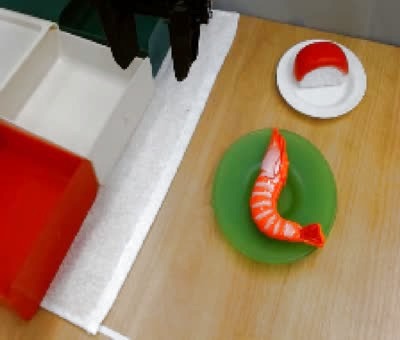
real-robot fine-tuning on both (sausage-in-pot, shrimp-in-drawer).
Applying TMRL to off-the-shelf VLAs. Noise the VLM embedding context with
qσ to allow π0 to sample across the conditional → marginal spectrum,
and let TMRL
learn how to interpolate at each step — broadening exploration where the base policy
collapses.
We fine-tune a context-smoothed π0 on
BridgeData-v2 (WidowX 250) and
DROID (Franka).
TMRL reaches near-perfect success on real-robot tasks in under an hour.
Base π0 stalls — its action support is too narrow for any rollout to succeed.
CSP widens that support; TMRL leverages it to reach near-perfect success on all three tasks.
Per-task rollouts
Base π0 versus context-smoothed π0, side by side. The learning curve below
traces the full RL training run.
Base π0
Context-Smoothed π0(ours)
Real-world RL learning curve
Button-Press
TMRL learns to be precise when it matters.
πHL treats the diffusion timestep σ as an adaptive exploration knob, choosing it per
action chunk. Below, the converged TMRL policy on shrimp-in-drawer learns to keep
σ low through the precision-critical pick and higher during reaching and placing.
“pick up the shrimp and put it into the white drawer”
Action Chunk 1 / 10
σ = 0.01
BibTeX
@inproceedings{hong2026tmrl,
    title  = {TMRL: Diffusion Timestep-Modulated Pretraining Enables Exploration for Efficient Policy Finetuning},
    author = {Hong, Matthew M. and Zhang, Jesse and Nagabandi, Anusha and Gupta, Abhishek},
    booktitle = {Robotics: Science and Systems (RSS)},
    year   = {2026}
}